There are two common ways to get a remodel or a new home designed and built. You can hire an architect or designer to draw the project, then take the drawings to contractors for bids. Or you can hire one design-build firm to handle both under a single contract. Both can produce excellent work. They differ in who answers for what, when you learn the cost and how much rides on one company.
This guide explains both models, what the research does and does not show, and how to choose. We are a design-build firm, so we have a point of view. There are still projects where hiring a separate architect is the right call, and we say which ones below.
- Design-build puts design and construction under one contract. Design-bid-build uses separate contracts, and the builder is usually chosen by bid once the drawings are done.
- Design-build gives you one point of responsibility and earlier cost feedback. Design-bid-build gives you bids on identical drawings and an architect who works for you rather than the builder.
- The performance study DBIA publishes covers commercial, industrial and multi-story buildings, not single-family homes.
- A separate architect makes the most sense for complex custom architecture and for landmark or closely reviewed historic buildings.
- Whichever route you take, get clear answers on responsibility, pricing and changes before you sign.
What the two models mean
The Design-Build Institute of America (DBIA) puts the difference in one line: "The single contract for both design and construction is the fundamental difference between design-build and other project delivery systems." In every other method, design and construction are under separate contracts.
The Federal Highway Administration's definitions are a useful plain-language version. In design-build, the design and construction phases "are combined into one contract." In the traditional design-bid-build approach, "two different contracting efforts must be undertaken in sequence": design first, then construction, procured on a "lowest-responsible-bid price basis."
On a house, design-bid-build usually looks like this: you hire an architect or designer, the drawings are finished, several contractors bid on them and you hire one. With design-build, one firm measures the house, draws the plans, arranges engineering, helps with selections, prices the work and builds it.
Design-build is still the less common route for homeowners. In Houzz's 2026 study, 29 percent of homeowners who renovated in 2025 hired a general contractor, 8 percent hired an architect and 5 percent hired a design-build firm, up two percentage points from the year before. Among kitchen renovators, Houzz's 2026 kitchen study found 13 percent hired a design-build firm.
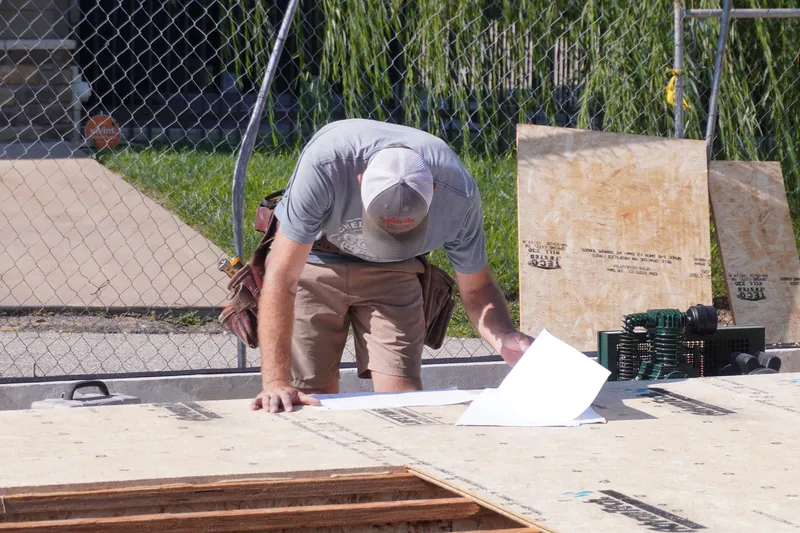
How they compare on a home project
| What differs | Design-build | Design-bid-build |
|---|---|---|
| Contracts | One, covering design and construction | Separate contracts with the designer and the builder |
| Who answers for problems | The design-build firm | The designer for the drawings, the builder for the work |
| When you learn the cost | Estimates develop with the design | When bids come in on finished drawings |
| Builder input during design | Built in from the start | Usually none until bidding |
| Price competition | Comes from comparing firms, not identical bids | Builders bid on the same drawings |
| Your advocate during construction | The firm you hired for both | Your architect, if hired for that phase |
Where design-build helps
One point of responsibility. If the drawings have a gap or an error, there is no architect-versus-contractor dispute to referee. The firm that drew it also has to build it, so it has to solve it.
Cost known earlier. In design-bid-build, you learn the construction price after you have paid for finished drawings. If bids come in over budget, redesign costs time and money. In what DBIA calls progressive design-build, the owner and design-builder "progressively advance the design and cost model toward a mutually agreeable design concept and contract price." In practice, you see what each option costs while it is still easy to change.
Collaboration. The person who knows what a beam, a moved drain or a custom window costs is in the room during design. In the CII and Pankow study discussed below, "earlier involvement of the builder" was among the conditions most influential in controlling both cost growth and schedule growth.
Fewer changes? Maybe. DBIA lists "fewer changes, fewer claims and less litigation" among design-build's benefits. That is an industry association's claim, drawn mostly from commercial work. And no delivery method prevents the changes you choose to make: in Houzz's 2026 study, 31 percent of homeowners who went over budget said they had changed the scope or design.
The tradeoffs
Less bidding on the build. With design-build you usually pick the firm before there is a final construction price. You can compare firms, design fees and early estimates, but not several bids on identical drawings.
You are trusting one firm. The same company designs the work and builds it, so no independent architect is checking the contractor on your behalf unless you hire one.
Design range varies. Design-build firms differ in the styles and project types they handle best. Look hard at the portfolio, and ask who exactly will design your project.
What the research shows, and what it does not
The study DBIA publishes on its website is "Revisiting Project Delivery Performance 1998 to 2018" by Keith Molenaar and Bryan Franz for the Construction Industry Institute and the Charles Pankow Foundation, updated January 2019. It analyzed 212 projects completed between 2008 and 2013: 53 design-bid-build, 79 construction manager at risk and 80 design-build. Of those, 62 percent were publicly funded, and the building types were light and heavy industrial buildings, multi-story dwellings, offices and high-technology facilities.
Compared with design-bid-build, the design-build projects were delivered 102 percent faster from design through completion and built 36 percent faster during construction. They also showed 3.8 percent less cost growth, 1.7 percent less schedule growth and 0.3 percent lower unit cost.
Read those numbers carefully. The buildings ranged from 5,000 square feet to over 1 million, and speed is measured as a rate (delivery speed in square feet per month), not as the length of a remodel. The cost and schedule differences are a few percentage points. We could not find comparable published data for single-family homes or remodels, so the honest conclusion is that design-build has a strong record on large buildings, and the case for houses rests on the same logic rather than on measured results.
When a separate architect makes sense
Design-build is not the right fit for every project. A separate architect is often the better choice when:
- The architecture is the point. A complex custom home, an addition with an unusual design, or a project where a particular designer's vision is the reason you are building at all.
- The building is a landmark or closely reviewed. In the City of St. Louis, exterior changes to City Landmarks and buildings in historic districts go through the Cultural Resources Office, and larger projects may go to the Preservation Board. For historic work, the National Park Service recommends "seeking assistance from qualified historic preservation professionals in the planning stage of the project," including architects and architectural historians. If you are pursuing Missouri historic tax credits, that expertise matters even more.
- You want bids on identical drawings, because price competition matters more to you than early cost feedback.
- You already work well with an architect. A good working relationship is worth a lot.
There is a middle path, too: hire an architect for the design and bring a builder in early to price the drawings as they develop. You keep an independent designer and get some of design-build's cost feedback.
What design services include
Whichever model you choose, someone has to produce the design. For a typical remodel or new home, that means:
- Architectural drawings: existing conditions, floor plans, elevations and the details a building department needs to review the work.
- Engineering when structure changes. St. Louis County, for example, requires structural drawings and calculations sealed by a Missouri architect or engineer for alterations to bearing walls, and Town and Country requires each set of building permit plans to carry the seal and signature of a Missouri registered architect or engineer.
- Interior design and selections: finishes, fixtures, cabinetry, lighting and the many decisions that make up a room.
- 3D renderings, which let you see the space before anything is built and settle questions of scale, color and light.
Modern Design + Build offers architectural drawings, engineering, interior design and 3D renderings alongside construction. Our design and planning page explains how they fit together.
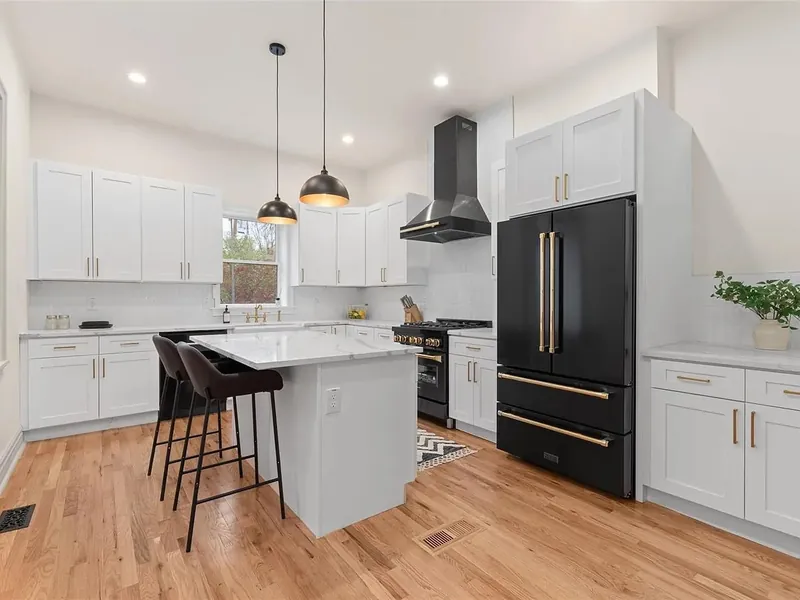
How pricing usually works in each model
Design-bid-build. You pay the architect or designer for design under their own agreement. Ask how the fee is set, what it includes and whether site visits during construction are part of it. Contractors then bid on the finished drawings, typically as a fixed price for the work shown. Anything not on the drawings, or chosen later, becomes a change order or is covered by an allowance, a placeholder amount for items such as tile or fixtures that have not been selected.
Design-build. Some firms charge for design under a separate design agreement first. Others fold design into the overall price. Ask which, and whether a design fee is credited if you go on to build. DBIA describes two common approaches: progressive design-build, where design and cost develop together toward an agreed contract price, and two-step best value, where qualified firms submit design and cost proposals and the owner picks the best value. Construction contracts in either model can be a fixed price or cost plus a fee, sometimes with a guaranteed maximum price. The CII and Pankow study names "cost plus a fee with a guaranteed maximum price (GMP)" as an example of open-book terms.
Either way, a price is only as good as the scope behind it. The fewer allowances and the more complete the drawings and selections, the more reliable the number. In Missouri, an original contractor generally must give you a written mechanic's lien notice before receiving payment, and the notice itself tells you that you may ask for lien waivers. Our guide to choosing a contractor in Missouri covers contracts and liens in more depth.
Questions to ask either way
- Who will design the project, and who will run the job day to day?
- If the drawings and the house do not match, who is responsible for the fix and the cost?
- When will I see a construction price, and what is it based on: finished drawings, allowances or estimates?
- How are changes requested, priced and approved?
- If a seal is required, who seals the drawings? Who pulls the permits and schedules inspections?
- For design-bid-build: will the architect visit the site and review the contractor's payment requests?
- For design-build: is the design fee separate, and is it credited if I go on to build? Can I take the drawings elsewhere if I do not?
- What does the warranty cover, and for how long?
- Can I see similar finished projects?
If you are weighing both routes, a first conversation costs nothing at Modern Design + Build. Book a free consultation and bring any drawings you already have. It is a good way to see how a design-build team would approach your project before you decide.
- What Is Design-Build?, Design-Build Institute of America
- Design-Build Effectiveness Study, Introduction (January 2006), Federal Highway Administration
- Revisiting Project Delivery Performance 1998 to 2018 (updated January 2019), Construction Industry Institute and Charles Pankow Foundation
- 2026 U.S. Houzz and Home Renovation Trends Study, Houzz
- 2026 U.S. Houzz Kitchen Trends Study, Houzz
- The Secretary of the Interior's Standards for Rehabilitation, National Park Service
- CRO Applications and Permits, City of St. Louis
- City Historic Districts, City of St. Louis
- Residential Repairs and Renovations Checklist and Guide, St. Louis County
- Building Permits and Inspections, City of Town and Country
- RSMo 429.012, Mechanic's lien notice, Missouri Revisor of Statutes